
Di Paola Redemagni
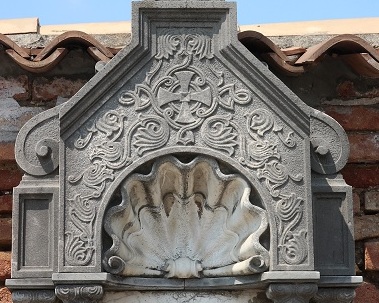
La conchiglia ha alle spalle una lunga tradizione simbolica che risale all’antichità e, come sempre, i significati connessi sono molteplici e diversi tra loro.
Se nell’arte funeraria rinascimentale e neoclassica le conchiglie sono presenti con una certa frequenza, non capita spesso di trovarle fra i simboli più usati all’interno del cimitero moderno.
Il tema ha origine pagana ma passa successivamente all’interno del repertorio iconografico cristiano e quindi può essere letto sia in senso laico che religioso.
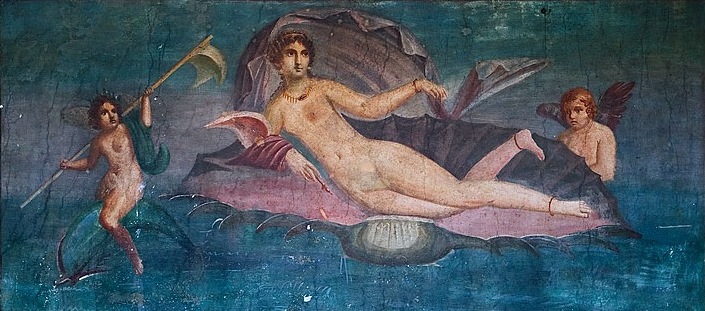
Dal punto di vista simbolico, già gli antichi Greci e Romani associavano la conchiglia agli organi femminili, forse per analogia di forma, collegandola così all’idea di nascita, di procreazione e di fertilità. La conchiglia diventa così attributo della dea Afrodite nel mondo ellenico, e di Venere in quello romano. Dee dell’amore – anche generatore – e dell’eros. E già negli affreschi di Pompei è una conchiglia che trasporta Venere sulla spuma del mare, nella rappresentazione della sua nascita.
Public domain by Wikipedia Commons.)
Per questo suo legame con l’acqua, Venere diventa a Roma protettrice dei viaggi per mare e quindi anche dell’ultimo viaggio: quello verso l’oltretomba. Alla conchiglia, suo attributo, vengono così associate l’idea di immortalità e di resurrezione. Di qui il suo uso in campo funerario, dove fa da sfondo ai ritratti dei defunti. La conchiglia viene spesso intagliata sulla fronte dei sarcofagi romani, dove incornicia e racchiude l’immagine di una coppia: anche in questo caso, quindi, viene associata all’idea dell’amore coniugale.
Nel cristianesimo il simbolo della conchiglia cambia significato: il suo guscio rappresenta la tomba che racchiude il corpo dopo la morte e prima della resurrezione. Mantiene tuttavia la relazione con il tema della rinascita e della purificazione spirituale, che possono essere ottenute attraverso il battesimo. Per questo i fonti battesimali e gli oggetti legati a questo rito spesso hanno forma di conchiglia. Ma la rinascita e la purificazione interiore possono essere raggiunte anche attraverso il pellegrinaggio: ed ecco che la conchiglia si lega così alla figura del pellegrino e ne diventa l’emblema, divenendo attributo anche dei santi Rocco e Giacomo l’apostolo. Chi tornava dopo aver compiuto il cammino fino a Santiago di Compostela portava con sé una conchiglia, simbolo delle opere buone.
(Dear friends speaking English, this is an home-made blog. I have no money to pay a professional translator, so I write English post by myself and – as you can see – I can’t write English language very well. So you can find a lot of mistakes in the articles: I beg your pardon. My English language level is: F(unny)! Will you pardon me?)
The symbol of the shell is ancient and has many different meanings.
If during the Renaissance and Neoclassic period is usual to see it in artworks, it’s not so common to see the shell on modern tombs.
We can find the shell as symbol in pagan era, then it pass in Christian iconography so it can owns both laical and holy meanings.
Ancient Greeks and Romans associated the shell with female organs, perhaps by analogy of shape, so they linked the shell to the idea of birth, procreation and fertility. So the shell became an attribute of the goddess Aphrodite in the Hellenic world, and of Venus in the Roman one. Goddesses of love – also generator – and of eros.
In ancient Rome myths, Venus is born from the waters of the sea and she was transported towards the seaside aboard a shell. So she became the protector of sea voyages and of the voyage towards the afterlife too.
The idea of immortality and resurrection are thus associated with the shell.
Hence its use in the funerary field. The shell is often carved on Roman sarcophagi, where it frames the image of the married couple as symbol of conjugal love.
In Christianity the symbol of the shell changes its meaning: its valves represent the tomb containing the body after the death and before the resurrection.
It maintains the relationship with the theme of rebirth and spiritual purification, which can be obtained through baptism. This is why the baptismal fonts and objects related to this rite often have the shape of a shell.
But rebirth and inner purification can also be achieved through pilgrimage: for this reason the shell also becomes the emblem of the pilgrim.
 Storie di cimiteri