
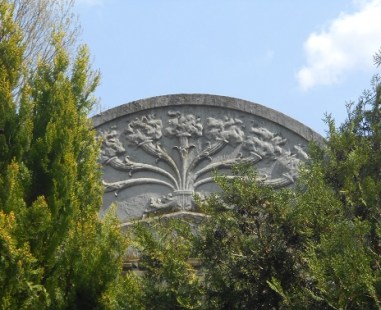
(Menorah. Cimitero Ebraico di Torino, foto dell’autore)
Di Paola Redemagni
Spunta fra gli alberi una Menorah, il candelabro a sette braccia che è uno dei simboli più antichi della religione ebraica, in cui i sette candelieri rappresentano i sette giorni della creazione e la luce una manifestazione divina.
Nella Bibbia (Esodo 24, 31-38) è Dio stesso a fornire a Mosè precise indicazioni per la sua realizzazione: “Farai un candelabro d’oro puro. Il candelabro con la base e il fusto sarà fatto d’oro battuto e i suoi calici, corolle e fiori saranno un tutt’uno con il candelabro. Sei bracci si distaccheranno dai lati; tre bracci del candelabro da un lato, tre altri dall’altro (…). Il tutto sia come una sola massa d’oro battuto” decorata da fiori di mandorlo forgiati in oro.
Ogni braccio regge una lampada: “Farai anche sette lampade; le lampade saranno disposte sul candelabro in modo da illuminare lo spazio davanti ad esso”, e sono alimentate da olio di oliva puro.
Insieme agli altri arredi sacri, la Menorah ornava il santuario “nomade” costruito da Mosè per l’Arca dell’Alleanza, santuario che accompagnò la popolazione durante i 40 anni delle sue peregrinazioni nel deserto. Entrò poi a far parte degli arredi sacri del Tempio di Gerusalemme e da qui fu trafugata dalle armate romane nel corso della conquista della città.
Poiché la legge mosaica rifiuta qualunque ostentazione e vieta l’uso di figurazioni sulle tombe, per secoli queste mantengono un aspetto molto semplice e anche le celebrazioni funebri si svolgono con grande rigore.
È solo a partire dall’Ottocento, con le leggi napoleoniche prima e quelle conseguenti all’unificazione del Regno d’Italia poi, che gli ebrei acquisiscono lo status di cittadini a pieno diritto, equiparati in tutto e per tutto agli altri cittadini italiani.
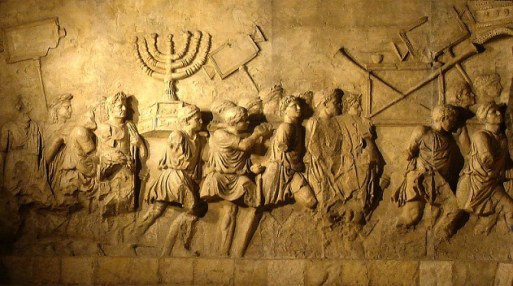
(Ricostruzione del bassorilievo dall’Arco di Tito. Steerpike (talk) Arc_de_Triumph_copy.jpg: user: בית השלום – Arc_de_Triumph_copy.jpg, CC BY 3.0, https://commons.wikimedia.org)
Durante l’800 questo processo di emancipazione si consolida e gli ebrei cominciano a adeguarsi agli usi e costumi dominanti. Contemporaneamente, cercano di elaborare un linguaggio simbolico e figurativo che sia loro proprio, mettendo a punto una iconografia funeraria ebraica rinnovata.
Non potendo rappresentare figure umane, si rivolgono ai simboli ed è in questo periodo che comincia a diffondersi con frequenza la Menorah, sovvertendo così quanto avveniva in precedenza. La sua prima raffigurazione si trova infatti nel bassorilievo presente sull’arco trionfale dell’imperatore Tito, a Roma, che celebra la distruzione del Tempio di Gerusalemme e il saccheggio dei suoi arredi, portati nella capitale come bottino.
Da simbolo della sconfitta subita, la Menorah diviene così simbolo identitario.
(Dear friends speaking english, this is an home-made blog. I have no money to pay a professional translator, so I write english post by myself and – as you can see – I can’t write English language very well. So you can find a lot of mistake in the articoles: I beg your pardon. My English language level is: F(unny)! Will you pardon me?)
In the Jewish religion, the Menorah is one of the most ancient symbol. It is a golden candelstick with seven arms. The seven arms represent the seven days of the Word creation.
In the Holy Bible (Exodus 24, 31-38) we can read what God orders: “And thou shalt make a candlestick of pure gold: of beaten work shall the candlestick be made: his shaft, and his branches, his bowls, his knops, and his flowers, shall be of the same. And six branches shall come out of the sides of it; three branches of the candlestick out of the one side, and three branches of the candlestick out of the other side: three bowls made like unto almonds, with a knop and a flower in one branch; and three bowls made like almonds in the other branch, with a knop and a flower: so in the six branches that come out of the candlestick. And in the candlestick shall be four bowls made like unto almonds, with their knops and their flowers. And there shall be a knop under two branches of the same, and a knop under two branches of the same, and a knop under two branches of the same, according to the six branches that proceed out of the candlestick. Their knops and their branches shall be of the same: all it shall be one beaten work of pure gold. And thou shalt make the seven lamps thereof: and they shall light the lamps thereof, that they may give light over against it. And the tongs thereof, and the snuffdishes thereof, shall be of pure gold”.
At the beginning, the Menorah stayed in the holy pavilion erected by Moses to host the Holy Ark, when Jewish people has been meandering for 40 years, all around the desert. Then Menorah was placed in the Jerusalem Temple and when Roman army destroyed the Temple, it was stolen. You can see the theft in a low relief on the Tito’s Arch, in Roma.
The Moses’ laws forbid to put human images on the gravestones. So the Jewish tombstones have been seeming very simple for a very long time. During the 19° century, Jewish people became to invent a figurative and symbolic style their own. So they produce a new Jewish funeral iconography and choose the Menorah as one of the most important and significant symbol of the Jewish tradition.
 Storie di cimiteri